Option Value - Understanding Premium
When you look at an option chain it can be confusing to know what the option bid/ask prices really mean and how they relate to the strike and stock price.
Before going deep into the mathematics of option pricing, I'm going to help you understand the bigger pieces that make up an option price.
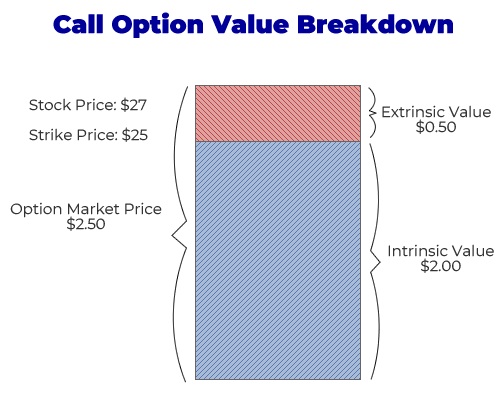
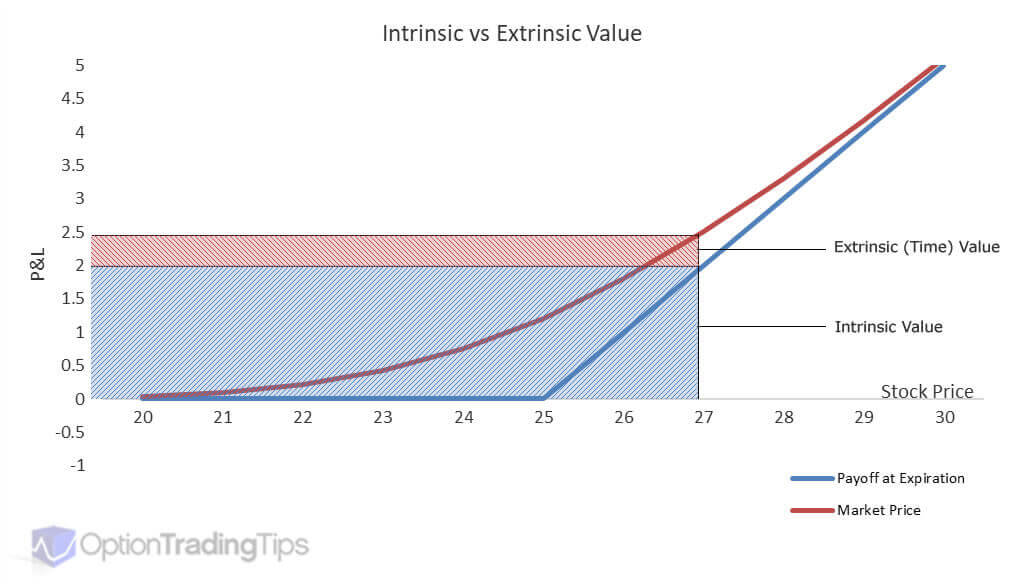
The price of an option can be represented by two components; Intrinsic Value and Extrinsic Value. These values combined make up the option's price. Take a look at these two example diagrams, I will reference these below.
Intrinsic Value
Intrinsic value is the amount of the option price that can be realized if the option is exercised. Only in-the-money options have intrinsic value.
Consider a $25 strike call option on a stock that is trading at $27.
Now, imagine that this particular call option is currently trading at $2.50. How can we better understand the meaning of this price?
Well, the first part we can look at is the option's exercise value; that is, if the option were exercised now, what would be the resulting profit.
If this option were exercised, the buyer of the option would take delivery of the shares with a purchase price of $25. The shares, however, are actually trading at $27, which means an immediate profit of $2.
This $2 is what is referred to as the Intrinsic Value; the value able to be realized if the option is exercised.
With the option priced at $2.50, we have $2 of Intrinsic Value. The remaining $0.50 is called Extrinsic Value.
Extrinsic Value
When the price of an option is trading at more than it's Intrinsic Value, the difference in price is what is called Extrinsic Value, or more commonly known as Time Value.
In our example, we determined that the option is intrinsically worth $2, but given that it is trading at a price of $2.50 means the $0.50 difference is the option's Extrinsic Value.
This $0.50 in time value represents the opportunity that the option still has remaining before it expires. More time means there is more chance that the stock will move in favor of the option buyer.
Options that are in-the-money or at-the-money will have premiums comprised of both intrinsic and extrinsic value. The amount of extrinsic value present in the price will depend on the time remaining until expiration and the implied volatility of the option.
Deep in-the-money options will have close to zero extrinsic value. And an out-of-the-money option price will 100% extrinsic value and 0 intrinsic value.
How to calculate Extrinsic Value?
Calculating the time value present in an option isn't as simple as calculating the intrinsic value; you will need the help of an option pricing model for that. If the option has a European exercise style then a Black and Scholes model will do and if the option has an American Style then you can look at a Binomial Model.
56 Comments
mark February 14th, 2010 at 8:23am
So, when I exercise an option that is in the money...above it's strike price....I actually purchase the underlying stock shares at my original options premuim purchase price? When options are exercised...they actually are converted to stock shares at the current stock value?
Peter February 14th, 2010 at 5:57am
Hi Mark, for a call option at expiration, the stock has to be above the strike the option to be profitable. However, options are tradable like many other assets on the market...that is, you can buy a call option for 20 cents while the stock is below the strike and then sell it the next day for 25 cents (if the market has move in your favor).
Mark February 9th, 2010 at 6:35pm
New to options! Does an option have to be above its strike price in order to make a profit? Also, if you sell an option before expiration, but below the strike price do you lose your total investment or just part of it as long as the price of the stock is above where you bought it. I am not sure how you make your money in options?
Peter September 12th, 2009 at 7:30am
Correct...the price shown in the market is 2 but the premium you pay is $200.
newbie September 11th, 2009 at 11:37am
srry m new 2. if i buy an option for say 2.00, if it's for 100 shares the value is 200.00 . Then premium price is also 200$ right?
Peter August 17th, 2009 at 6:51am
Hi Adnan,
1) For a call option the intrinsic value is underlying price - strike price. In your example, the instrinsic value is $8 ($33 - $25).
2) Time Value depends on the volatility. See my spreadsheet under the Pricing link above for an idea how option pricing works.
3) Option value = intrinsic value + time value. If you buy an option you pay the value (i.e. premium) to the option seller.
adnan jahangir August 14th, 2009 at 1:50am
Me want to know the exact basics. my example is
If i bought option of 20$ with strike price of 25$ for 3 months at the date of expiry underlying asset is having price of 33$ what are
1) intrinsic value and to whom it will go to holder of option or writer.
2) what is time value to whom it will go holder or writer
3) what is the option value and to whom it belong writer or holder.
please explain those in call option .hopping that my question is complete .
Peter July 10th, 2009 at 7:34am
Hi Thomnel,
You would pay $200 for the option and your maximum loss would therefore be $200.
thomnel53 July 5th, 2009 at 3:43pm
o.k. so if you buy an option for say 2.00, if it's for 100 shares the value is 200.00 right. Do you pay 2.00 or 200.00 for it, and if it tanks do you only lose the 2.00 or what? sorry i'm new.
Peter May 11th, 2009 at 6:28pm
Hi Joe, yes, $37 in the above represents the exercise price. I used $30 and $36 to represent two examples of MSFT share prices.
Add a Comment