Black-Scholes Option Model
The Black-Scholes Model was developed by three academics: Fischer Black, Myron Scholes and Robert Merton. It was 28-year old Black who first had the idea in 1969 and in 1973 Fischer and Scholes published the first draft of the now famous paper The Pricing of Options and Corporate Liabilities.
The concepts outlined in the paper were groundbreaking and it came as no surprise in 1997 that Merton and Scholes were awarded the Noble Prize in Economics. Fischer Black passed away in 1995, before he could share the accolade.
The Black-Scholes Model is arguably the most important and widely used concept in finance today. It has formed the basis for several subsequent option valuation models, not least the binomial model.
What Does the Black-Scholes Model do?
The Black-Scholes Model is a formula for calculating the fair value of an option contract, where an option is a derivative whose value is based on some underlying asset.
In its early form the model was put forward as a way to calculate the theoretical value of a European call option on a stock not paying discrete proportional dividends. However it has since been shown that dividends can also be incorporated into the model.
In addition to calculating the theoretical or fair value for both call and put options, the Black-Scholes model also calculates option Greeks. Option Greeks are values such as delta, gamma, theta and vega, which tell option traders how the theoretical price of the option may change given certain changes in the model inputs. Greeks are an invaluable tool in portfolio hedging.
Black-Scholes Equation
Call Option = 
Where:
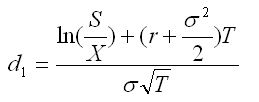
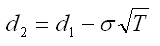
Given Put Call Parity:

The price of a put option must therefore be:

Black-Scholes Excel


Black-Scholes VBA
Function dOne(UnderlyingPrice, ExercisePrice, Time, Interest, Volatility, Dividend)
dOne = (Log(UnderlyingPrice / ExercisePrice) + (Interest - Dividend + 0.5 * Volatility ^ 2) * Time) / (Volatility * (Sqr(Time)))
End Function
Function NdOne(UnderlyingPrice, ExercisePrice, Time, Interest, Volatility, Dividend)
NdOne = Exp(-(dOne(UnderlyingPrice, ExercisePrice, Time, Interest, Volatility, Dividend) ^ 2) / 2) / (Sqr(2 * 3.14159265358979))
End Function
Function dTwo(UnderlyingPrice, ExercisePrice, Time, Interest, Volatility, Dividend)
dTwo = dOne(UnderlyingPrice, ExercisePrice, Time, Interest, Volatility, Dividend) - Volatility * Sqr(Time)
End Function
Function NdTwo(UnderlyingPrice, ExercisePrice, Time, Interest, Volatility, Dividend)
NdTwo = Application.NormSDist(dTwo(UnderlyingPrice, ExercisePrice, Time, Interest, Volatility, Dividend))
End Function
Function CallOption(UnderlyingPrice, ExercisePrice, Time, Interest, Volatility, Dividend)
CallOption = Exp(-Dividend * Time) * UnderlyingPrice * Application.NormSDist(dOne(UnderlyingPrice, ExercisePrice, Time, Interest, Volatility, Dividend)) - ExercisePrice * Exp(-Interest * Time) * Application.NormSDist(dOne(UnderlyingPrice, ExercisePrice, Time, Interest, Volatility, Dividend) - Volatility * Sqr(Time))
End Function
Function PutOption(UnderlyingPrice, ExercisePrice, Time, Interest, Volatility, Dividend)
PutOption = ExercisePrice * Exp(-Interest * Time) * Application.NormSDist(-dTwo(UnderlyingPrice, ExercisePrice, Time, Interest, Volatility, Dividend)) - Exp(-Dividend * Time) * UnderlyingPrice * Application.NormSDist(-dOne(UnderlyingPrice, ExercisePrice, Time, Interest, Volatility, Dividend))
End Function
You can create your own functions using Visual Basic in Excel and recall those functions as formulas within your chosen workbook. If you want to see the code in action complete with Option Greeks, download my Option Trading Workbook.
The above code was taken from Simon Benninga's book Financial Modeling, 3rd Edition. I highly recommend reading this and Espen Gaarder Haug's The Complete Guide to Option Pricing Formulas
. If you're short on option pricing formulas texts, these two are a must.


Model Inputs
From the formula and code above you will notice that six inputs are required for the Black-Scholes model:
- Underlying Price (price of the stock)
- Exercise Price (strike price)
- Time to Expiration (in years)
- Risk Free Interest Rate (rate of return)
- Dividend Yield
- Volatility
Out of these inputs, the first five are known and can be found easily. Volatility is the only input that is not known and must be estimated.
Black-Scholes Volatility
Volatility is the most important factor in pricing options. It refers to how predictable or unpredictable a stock is. The more an asset price swings around from day to day, the more volatile the asset is said to be. From a statistical point of view volatility is based on an underlying stock having a standard normal cumulative distribution.
To estimate volatility, traders either:
- Calculate historical volatility by downloading the price series for the underlying asset and finding the standard deviation for the time series. See my Historical Volatility Calculator.
- Use a forecasting method such as GARCH.
Implied Volatility
By using the Black-Scholes equation in reverse, traders can calculate what's known as implied volatility. That is, by entering in the market price of the option and all other known parameters, the implied volatility tells a trader what level of volatility to expect from the asset given the current share price and current option price.
Assumptions of the Black-Scholes Model
1) No Dividends
The original Black-Scholes model did not take into account dividends. Since most companies do pay discrete dividends to shareholders this exclusion is unhelpful. Dividends can be easily incorporated into the existing Black-Scholes model by adjusting the underlying price input. You can do this in two ways:
- Deduct the current value of all expected discrete dividends from the current stock price before entering into the model or
- Deduct the estimated dividend yield from the risk-free interest rate during the calculations.
You will notice that my method of accounting for dividends uses the latter method.
2) European Options
A European option means the option cannot be exercised before the expiration date of the option contract. American style options allow for the option to be exercised at any time before the expiration date. This flexibility makes American options more valuable as they allow traders to exercise a call option on a stock in order to be eligible for a dividend payment. American options are generally priced using another pricing model called the Binomial Option Model.
3) Efficient Markets
The Black-Scholes model assumes there is no directional bias present in the price of the security and that any information available to the market is already priced into the security.
4) Frictionless Markets
Friction refers to the presence of transaction costs such as brokerage and clearing fees. The Black-Scholes model was originally developed without consideration for brokerage and other transaction costs.
5) Constant Interest Rates
The Black-Scholes model assumes that interest rates are constant and known for the duration of the options life. In reality interest rates are subject to change at anytime.
6) Asset Returns are Lognormally Distributed
Incorporating volatility into option pricing relies on the distribution of the asset’s returns. Typically, the probability of an asset being higher or lower from one day to the next is unknown and therefore has a 50/50 probability. Distributions that follow an even price path are said to be normally distributed and will have a bell-curve shape symmetrical around the current price.
It is generally accepted, however, that stocks – and many other assets in fact – have an upward drift. This is partly due to the expectation that most equities will increase in value over the long term and also because a stock price has a price floor of zero. The upward bias in the returns of asset prices results in a distribution that is lognormal. A lognormally distributed curve is non-symmetrical and has a positive skew to the upside.
Geometric Brownian Motion
The price path of a security is said to follow a geometric Brownian motion (GBM). GBMs are most commonly used in finance for modelling price series data. According to Wikipedia a geometric Brownian motion is a “continuous-time stochastic process in which the logarithm of the randomly varying quantity follows a Brownian motion". For a full explanation and examples of GBM, check out Vose Software.
61 Comments
Peter August 14th, 2018 at 10:25pm
Hi Gary,
No, dTwo = dOne(UnderlyingPrice, ExercisePrice, Time, Interest, Volatility, Dividend) - Volatility * Sqr(Time). So if you change the last part of that formula you will double up on the -Volatility * Sqr(Time) component.
You are welcome to try but when I did this for an ATM call/put the call price doubled the price of the put. If interest rates and divs are zero, the call and put price should match for an ATM strike.
Also, I've made some changes to the spreadsheet so the VBA is a little clearer. The old "CallOption" functions are still there but I've also added a new module that makes the calculations easier to read:
Option Workbook
Gary August 13th, 2018 at 9:37pm
Hi,
I was reviewing this page so I could use the formulas. Thank you for providing this information.
I do have a question on the CallOption function VBA code on this page. Shouldn't this last part of the calculation be changed from Application.NormSDist(dOne(UnderlyingPrice, ExercisePrice, Time, Interest, Volatility, Dividend) - Volatility * Sqr(Time) to Application.NormSDist(dTwo(UnderlyingPrice, ExercisePrice, Time, Interest, Volatility, Dividend) - Volatility * Sqr(Time)?
I am not an expert by any means. However, I get the answer you show when I make this change. I apologize if this has been discussed before. I did not read thru all comments.
Thank you!
Peter April 21st, 2018 at 12:53am
Hi Prakash,
The formula itself doesn’t consider holidays but the user would consider holidays and other non-trading days in determining the number of days until expiration. This number would then be used in the formula.
Prakash April 19th, 2018 at 5:20am
In this formula Market holidays not considered, is there any way for considering the market holidays ?
SHAKEEL AHMED June 10th, 2017 at 11:02am
Black Scholes model/formula/equation is very complicated.Some calculator based on it is very useful.Using this calculator,I have observed something.I have taken data like this.Call option,spot price=110,strike price=100,risk free interest=10%,expiry time=30 days,implied volatility=30%,but it reduces daily @1%.All datas are imaginaries.Only theoretical datas of option premium are derived.Analysis,on 10th day,premium drops from 11.31 to 10.61=0.70,on 20th day,premium drops from 10.61 to 10.30=31,on 30th day,premium drops from 10.30 to 10.02=0.28.If option is in 10% of in-money,it is profitable from 1.31 to 0.02 anywhere.1st 10 day,volatility is good,if direction is ok,profit will be @0.10.Last 10 day,volatility is low,if direction is ok,profit will be @0.03.Result,use in-money option,trading in 1st 10 days of 30 days movement,keep direction in your favour.True direction is real winning formula,not B/S-formula,i think so.
Peter March 8th, 2017 at 10:59pm
Are you using the file black-scholes-excel.xls? It works fine for me...have you "enabled" the content when opening the document?
Anonymous March 2nd, 2017 at 7:50am
Your calculator is not calculating correctly for stocks so kindly fix it.
Regards
Peter February 28th, 2016 at 6:32pm
Hi Matt,
It is not possible to value the option without knowing the value of the underlying asset. A published market share price would be considered the most accurate, however, it is not the only way to value a company.
There are other methods of valuing a company, provided you have access to the necessary information. You might want to consider evaluating the methods listed below in order to arrive at a valuation price for the company:
Stock Valuation Methods
Matt February 27th, 2016 at 8:51pm
Hello, I am trying to figure out what to input in the market price with an employee stock option when the strike price is $12.00, but the stock is not yet publically traded and therefore there is no stock price to input. Can the Black Scholes equation be used in this case.
I am an attorney, and the Judge (also not a financial person) has suggested looking at this method to value the option.
It is my position that the option cannot be valued at this time, or until it is actually exercised.
Any input and advise would be greatly appreciated. I can be reached at [email protected]
Dennis April 24th, 2015 at 2:30am
Hi Peter/Bruce
The reason that doesn't work for OTM/ITM options, is that by changing the Implied Vola, you effectively alter the theoretical chance the option has to get in the money...
So, for instance, by halving IV... an OTM option might already have near-zero chance to get ITM and so no value. The further OTM the option is, the sooner it will have zero value when altering IV.
For ATM call and put options, they will have no intrinsic value and their value therefore solely depends on Implied Volatility (given a certain Maturity etc).
So with ATM:
let's say IV of 24, Call value is 5, Put value is 5
IV of 12, Call value is 2.5, Put value is 2.5
IV of 0, both have zero value... (since the stock is assumed not to move and generate value for ATM options).
Cheers, Dennis
Add a Comment