Buying a Call Option
| B/S | Strike | Type | Price |
|---|---|---|---|
| Buy 1 | $45 | Call | $1.29 |
| Net Debit | $129 | ||
A long call option gives the buyer the right to buy the underlying asset at the strike price. The option buyer pays a premium for this right to the seller of the option.
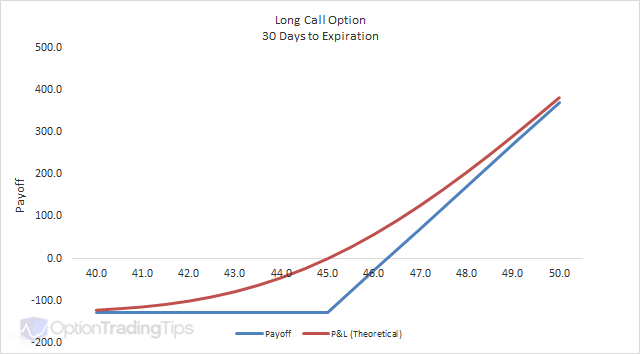
The Max Loss will only ever be the premium that is paid up front to buy the option.
The Max Gain is uncapped and will rise with as long as the underlying price rises.
Characteristics
When to use: When you are bullish on market direction and also bullish on market volatility.
A long call option is the simplest way to benefit if you believe that the market will make an upward move and is the most common choice among first time investors.
Being long a call option means that you will benefit if the stock/future rallies, however, your risk is limited on the downside if the market makes a correction.
From the above graph you can see that if the stock/future is below the strike price at expiration, your only loss will be the premium paid for the option. Even if the stock goes into liquidation, you will never lose more than the option premium that you paid initially at the trade date.
Not only will your losses be limited on the downside, you will still benefit infinitely if the market stages a strong rally. A long call has unlimited profit potential on the upside.
Long Call Greeks
Delta


Gamma


Vega


Theta


201 Comments
Stuart December 11th, 2011 at 10:23am
Hello Peter, Let me first say you are the first person on this topic who like a great teacher can take complex subject matter and break it down so the plebes can grasp it. Then with a sound base camp you help provide, climb the complex mountain of options trading on our own. My question is: I bought 45 contracts long calls with 11 strike price six weeks ago out of the money and with lady luck by my side the co. declared to renew its dividend. So, I'm in the money and am very bullish on this stock. Is it prudent to roll over the contract, ( and at what strike price, I feel 13 is in the cross hairs ) or allow the contract to expire, take on the shares, and ride it, hopefully up?
Peter November 9th, 2011 at 7:05pm
Hi David,
1) As you said, your broker may provide the margin for you to buy the stock or you can borrow more money. You cannot transfer your position though.
The better choice would be to simply close out your option position by selling the option back on the expiration date.
2) The premium is the amount that you paid when you first put on the trade. You don't get this money back as this is paid to the seller of the option. If you exercise the option you will buy the stock with the price paid being the strike price.
David November 7th, 2011 at 6:51pm
QUESTION
1) If I want to exercise a call option and I don't have the money to buy the stock, can I get a loan from a securities lending company, or can I assign the option to someone who can exercise the option and cut me a check for my share? - For example, my broker gives me 2:1 ratio on my money; but I needed to get the 50% of the initial funds.
2) If I exercise the option, what happens to the premium I paid? Is the premium part of the strike price or is it extra. Meaning, do I pay the premium + the strike price or do I just pay the strike price, which includes the premium I paid?
Thank you.
Peter November 2nd, 2011 at 4:58pm
What was the stock price before and what was the change in the option price?
The decision really depends on your view of the stock - if you think there is more upside potential, then you'd hold onto the position for more gains. Otherwise, if you're happy with the % profit achieved already then take it.
aa November 1st, 2011 at 9:49am
A call option contract (American option) from september 10 to october 10 with premium $5 per contract. the stock price goes up to $78 .what should u do? (for each american and european option) explain
Peter October 14th, 2011 at 6:39am
Yep - you can close out the long position by selling the option and take the profits of the higher sold price.
The downside to trading options this way if you are bullish on a stock is the time factor: that the stock must increase - and increase enough - before the expiration date for the option to be profitable. Otherwise you will lose your entire premium investment that you paid when you bought the option initially.
When you buy stocks outright you have time on your side that the price will rise "sometime" in the future to profit.
Roshan October 14th, 2011 at 5:00am
Thank you Peter
I wasn't aware of this alternative. So what I have come to understand is that 'exercising' and 'closing' the option are two ways for closing out my options position.
So I assume to close out of my option position I could enter an offsetting order to sell the call option at the "new" higher price and pocket the difference in premiums as a profit? Please correct me if I am wrong.
Also I wonder why do so many people waste time and money by buying stocks and holding onto them for months and years to realize profit, when they can make huge profit with options sometimes even 100% in a weeks time.
Peter October 14th, 2011 at 4:03am
Hi Roshan, you can profit by the increase in the option price by simply selling the back the option in the option market (closing out your option position).
If you exercise the option you will be assigned the stock, which means you will have to have enough capital to take delivery of the stock. And then you will have to sell the stock at the current price to take profits.
I.e. the better alternative is to just close out your long call position and make the 50% increase in premium.
Roshan October 14th, 2011 at 1:46am
Hi Peter,
1 quick question.
stock A market price 90
call option: A100 trading at a premium 5
now 10 days to expiry Stock A reaches 98(still not hit the strike price) but trading at a premium 7.5
can I exercise my option and profit from the 50% increase in the premium?
Peter October 10th, 2011 at 7:23pm
Hi Annu,
Yes, you can sell (close out) the long call option before the expiration date.
You will receive money by doing this, which will offset the cost you paid when buying the option.
So, you paid $5 to buy the option and then received $4 when you sold it back - resulting in a loss of $1.
Add a Comment