Buying a Call Option
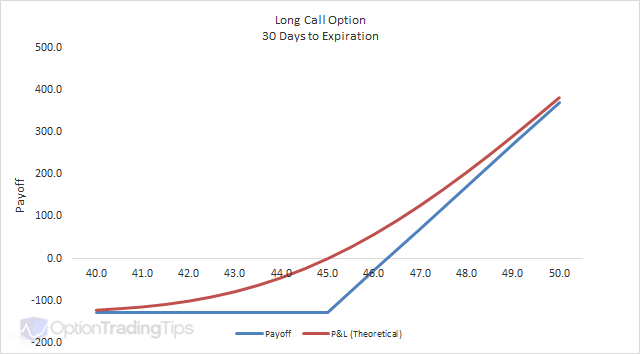
| B/S | Strike | Type | Price |
|---|---|---|---|
| Buy 1 | $45 | Call | $1.29 |
| Net Debit | $129 | ||
A long call option gives the buyer the right to buy the underlying asset at the strike price. The option buyer pays a premium for this right to the seller of the option.
The Max Loss will only ever be the premium that is paid up front to buy the option.
The Max Gain is uncapped and will rise with as long as the underlying price rises.
Characteristics
When to use: When you are bullish on market direction and also bullish on market volatility.
A long call option is the simplest way to benefit if you believe that the market will make an upward move and is the most common choice among first time investors.
Being long a call option means that you will benefit if the stock/future rallies, however, your risk is limited on the downside if the market makes a correction.
From the above graph you can see that if the stock/future is below the strike price at expiration, your only loss will be the premium paid for the option. Even if the stock goes into liquidation, you will never lose more than the option premium that you paid initially at the trade date.
Not only will your losses be limited on the downside, you will still benefit infinitely if the market stages a strong rally. A long call has unlimited profit potential on the upside.
Long Call Greeks
Delta


Gamma


Vega


Theta


201 Comments
Peter April 17th, 2011 at 6:06pm
Almost - intrinsic and extrinsic value are terms that relate to the market price of the option when compared its strike and underlying price.
The graph above doesn't look at the market price of the option - the blue line simply represents your profit and loss of buying the option.
Ashutosh April 17th, 2011 at 10:40am
Thanks Peter,
Thanks for the prompt reply. Actually I was confused but a bit later when I went through the whole site I got it before your post here.
Actually you have posted everything in nice and short manner. I really appreciate your work on this.
In above scenario....long call,
when it's ITM then the (strike price)line below x axis would be...Intrinsic+Time value(premium paid)......m i right?
Please correct me if I am wrong.
Thanks in advance
Peter April 17th, 2011 at 6:10am
Hi Ashutosh, the -1 line beneath indicates the loss of the option while the stock price remains below the strike price. For a long call option this value is the price you pay for the option - as this is the maximum you can lose with this position.
The -1 in the graph is just an example but would otherwise equal the price you have paid for the option.
Ashutosh April 16th, 2011 at 1:49pm
Peter, Nice, Elaborate info On Options.
One query,
I couldn't understand the graph.
As here in Long Call,
On Y-Axis ..... -2 to +5
On X-Axis ..... 20 to 30
I don understand why The Call has started from -1.
Please clarify.
Peter April 13th, 2011 at 8:28pm
Hi Maria, you could try Option Sizzle they have a subscription service where they provide short term option trade ideas.
maria April 13th, 2011 at 3:46pm
Peter-Is there any site you use that would list good value option bets i.e--where the options don't cost that much per contract and the call/ underlying stock has a good probability of increasing in value?
Peter April 10th, 2011 at 8:35pm
The payoff for a long call option is max(0, Stock - Strike).
The cash flow when you short an option is simply the premium received when the trade is established.
Wade April 10th, 2011 at 8:21pm
How do you get the cash flow of exercising the long call is St-X and the cash flow of exercising the short call is -(St- X)? Could u explain a bit more? Cheers
Peter February 12th, 2011 at 9:05pm
Hi Alex,
It is only referred to as writing an option if your position is short. In your case, you already have a long position so to sell an option is just closing out that position.
Alex February 12th, 2011 at 2:57pm
Hi Peter,
I have a question. So lets say I bought a call option for $1 with a strike price of $10. In a month the price of the stock went up to $12. which means that my call option right now cost $2.
So, right now I want to sell that option back. Does it mean that I am actually writing a call option? And if before the expatriation price of the stock will go further up I will lose money, and will have to buy back stock at the strike price?
Or it simply means that I am closing my position and will not have to fulfill any other obligations?
Thanks
Add a Comment