Buying a Call Option
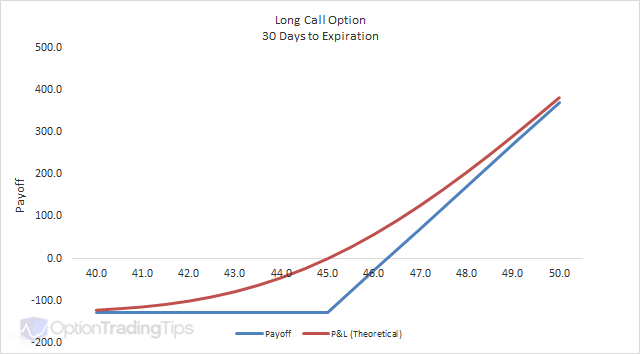
| B/S | Strike | Type | Price |
|---|---|---|---|
| Buy 1 | $45 | Call | $1.29 |
| Net Debit | $129 | ||
A long call option gives the buyer the right to buy the underlying asset at the strike price. The option buyer pays a premium for this right to the seller of the option.
The Max Loss will only ever be the premium that is paid up front to buy the option.
The Max Gain is uncapped and will rise with as long as the underlying price rises.
Characteristics
When to use: When you are bullish on market direction and also bullish on market volatility.
A long call option is the simplest way to benefit if you believe that the market will make an upward move and is the most common choice among first time investors.
Being long a call option means that you will benefit if the stock/future rallies, however, your risk is limited on the downside if the market makes a correction.
From the above graph you can see that if the stock/future is below the strike price at expiration, your only loss will be the premium paid for the option. Even if the stock goes into liquidation, you will never lose more than the option premium that you paid initially at the trade date.
Not only will your losses be limited on the downside, you will still benefit infinitely if the market stages a strong rally. A long call has unlimited profit potential on the upside.
Long Call Greeks
Delta


Gamma


Vega


Theta


201 Comments
Peter February 10th, 2011 at 1:50pm
No worries, good luck!
Joann February 10th, 2011 at 11:16am
Peter,
Great Advice! Simple and clear! Yes, I think it is a covered call. And from you, I know that I am a option holder of a short call.
Thank you very much. I am watching everyday now to catch the right 'price' as the market seems to cool down a bit. That is what I need. Sorry! It is just a timing issue.
Take care!
Regards,
Joann
Peter February 9th, 2011 at 9:05pm
Hi Joann,
So, you own the stock as well as the short call option, right i.e. a covered call?
If so, then you've probably already capped out in terms of your upside gains? The short option will keep losing money as the stock rises but these losses will be offset by the gains on the stock.
If you are still bullish on the stock, then buy back the call option and continue to hold the stock.
Joann February 8th, 2011 at 5:16pm
Hi, Peter,
I've been stuck for a little while and just found you!
I have been trading option in a very simple way with my existing ABC stocks and was doing fine since the stock does not go up and down a lot.
But in the last two weeks, it went up more than 20%, so I began to get nervous b/c I might loss those stocks which I do not intend to sell. (big captial gain)
I 'sell to open' an option (not sure if it is called short call) to SELL ABC at 150 by 1/2012 for 10 contract and got 8.00 premium/sh collected in late 2010.
Now ABC is worth 165 and the same option symbol is at 21.00 premium/sh.
Normally I knew I can 'buy to close' the option when the gap isn't big and can still make a profit.
But this time, the gap is quite large and negative.
21-8 = 13/shr
I am debating on doing one of the following:
1. should I spent 13000.0 to buy back my stocks and turn around to 'sell to open' at a higher strike price (like 190 w/ 19/shr) to offset my loss of 13000.0 or
2. should I sit on the current option and hope the market will cool down a bit before 1/2012 and take back with a <=8 premium/shr. to keep my small gain and still keep my ABC stocks or
3. should I just let my option being taken and then face the captical gain tax (I estimate the gain to be 60000 (60*1000).
Someone told me that since my expiration date is 10 month away, normally folks (option buyer) won't exercise my option as yet. How close to 1/2012 should I start to worry?
I have yet to digest/understand about all the bells and whistles about option, so my question might be not be stated very professional.
Hope you could understand my question and looking forward for your wise advices.
Joann
Peter February 6th, 2011 at 9:36pm
Good stuff mate! How did your trades end up?
Joshua February 6th, 2011 at 6:19pm
This has been a great help Peter. I cant say thank you enough. I just made my first call buys last week. Keep up the good work.
Peter February 3rd, 2011 at 9:44pm
You trade options on an exchange, which means (unless you're an exchange member) that you have to go through a broker.
kumar February 3rd, 2011 at 8:46pm
How do you really enter in the options contract. if i want to trade in options, what should be my approach. do i have to deal with options only through a broker
Peter January 15th, 2011 at 6:50am
Hi Wen,
Sure, the X-Axis represents the stock price and the Y-Axis is the Profit and Loss (P&L).
The blue line shows the actual profit/loss of the option at the expiration date of the option. And the pink line shows the theoretical profit/loss of the option with 60 days left to expiration.
So, with this example, if the stock price is below $26 at the expiration date of the option you will lose money, which is represented by the blue line. The profit you will make above $26 is shown as the line increases to the right.
Wen January 14th, 2011 at 9:53am
Hi Peter,
Thank you so much for the site. Great work.
I need your help understanding the graphs. I tried to grasp but I couldn't make out. Could you please explain what is on the X-axis, Y-axis, what is P&L, what is P&L at expiration, P&L +60 days. What are 20 21 22 ... 30 , -2,-1,...5.
I read your response to another question on graphs on this page, but could not get the point.It will be very helpful if you take an example to explain this.
Thanks in advance,
Wen
Add a Comment