Buying a Call Option
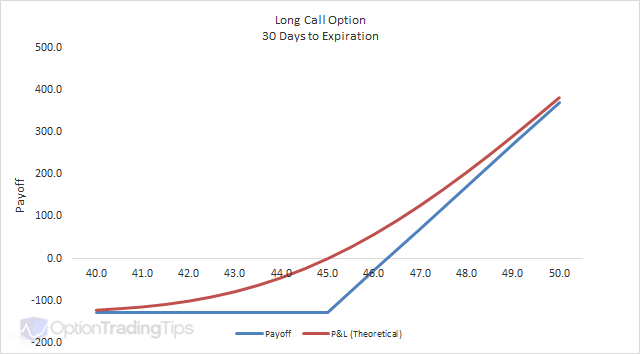
| B/S | Strike | Type | Price |
|---|---|---|---|
| Buy 1 | $45 | Call | $1.29 |
| Net Debit | $129 | ||
A long call option gives the buyer the right to buy the underlying asset at the strike price. The option buyer pays a premium for this right to the seller of the option.
The Max Loss will only ever be the premium that is paid up front to buy the option.
The Max Gain is uncapped and will rise with as long as the underlying price rises.
Characteristics
When to use: When you are bullish on market direction and also bullish on market volatility.
A long call option is the simplest way to benefit if you believe that the market will make an upward move and is the most common choice among first time investors.
Being long a call option means that you will benefit if the stock/future rallies, however, your risk is limited on the downside if the market makes a correction.
From the above graph you can see that if the stock/future is below the strike price at expiration, your only loss will be the premium paid for the option. Even if the stock goes into liquidation, you will never lose more than the option premium that you paid initially at the trade date.
Not only will your losses be limited on the downside, you will still benefit infinitely if the market stages a strong rally. A long call has unlimited profit potential on the upside.
Long Call Greeks
Delta


Gamma


Vega


Theta


201 Comments
Joey October 19th, 2010 at 3:05pm
Hey Peter,
I have a question that pertains to the following info below.
1)When purchasing a Long Call Option with a strike price of $8.00 for a stock that is trading at $17.00, I see the bid/ask price is around $9.80. Does this mean that I have to pay $980 ($9.80 X 1 contract of 100 shares) + Contract Fee of broker(scottrade $.50 a share) + Commission fee to Broker website?
Or, do you just pay the $9.80 for one contract + Contract fee (lets say $.50 a share) + Commission fee to broker website?
2) Addtionally, if I purchase a three month expiry long call based on the above info (Strike=$8.00, Underlying Stock now trading at $22.00, and only 1 contract purchased), and let's say within 2 months I am in the money, how would I go about executing a profit? I read that I could sell the option back to the market, but isn't that different than executing the option and realizing a profit of $14.00 (22-8) minus any commission and contract fees paid?
Thanks,
Joey
Peter October 19th, 2010 at 1:17am
Hi Kaushik,
The price of an option is made up of two components: intrinsic and extrinsic value. The time value you refer to is the extrinsic part...intrinsic is the amount where if you exercised now would be realised immediately.
So, if the stock has traded up to $35 and you are long a $30 call then the option is worth "at least" $5 (i.e. plus any time/volatility value). You're now in the money on the trade of $4. If you are not interested in owning the stock then you would just sell the option and take the profit. Unless you thought there was still room for the stock to move upwards, then you might want to hold onto the option.
Make sense?
kaushik October 18th, 2010 at 8:01pm
Hello Peter,
Gr8 explanations, But i have a doubt, it really fundamental but want to calify
SENARIO:
lets say ABC is 25, i buy a call option for ABC 30 for June 2011 epry @ 1.0 ....the stock didnot do well till june, but suddenly went to 35 in july 2 week.....
but as the call option is expriring soon, it should have lost good amount of value due to time decay....(Q1)will option be worth less than wht i bought for because of time decay, even though the stock is way ahead of strike??
Q2)) so at this point instead of trading out should i excerise the option (buying the stocks)because im In The Money. please explain me how to be prudent in this situ.
Peter September 30th, 2010 at 6:45am
Hi Phil, the P&L graph is essentially the time value. It is the theoretical P&L now with an option that expires in 60 days.
Phil September 30th, 2010 at 4:22am
Hi Peter,
I'm having a little difficulty understanding your graphs. The horizontal axis is the underlying price I assume, the vertical axis is maybe moneyness? What does P&L stand for and why the difference between expiration and +60days? What about the time-value of the option combinations?
appreciate your help, regards
Peter September 23rd, 2010 at 6:04am
Hi Joe, yes you can sell the call back in the option market. In this case the "selling" of the option is just closing out a position. It is only called "writing" when you are "short" the option.
Joe September 21st, 2010 at 3:05am
Ok I'm a little confused here. Let's say I buy a call. This means I have the right to buy at a given price. Now lets say the value of stock reaches higher than the strike price. Is there a way to realize the profit without actually buying the underlying stock? Do I sell the call to someone else? Is this the same as writing a call?
Peter September 20th, 2010 at 1:43pm
Hi John, you're absolutely right! Options are a decaying asset where the value/chances erode every day. It doesn't mean that you cannot make money with them...they are still highly leveraged instruments but as you say you have to get the direction AND time right for options to be profitable.
John September 20th, 2010 at 10:38am
I have a couple questions on long calls; perhaps someone can offer guidance on this...
Assume ABC is trading today at $10/share and I expect that the price will increase over the next year or two. If I wish to profit from this I can either 1) buy actual shares of ABC or 2)buy a call option.
If I buy call option, say for example a January 2012 $10 call, what I'm essentally buying is the right to purchase shares of ABC for $10 on or before January 31, 2012. But if the price of ABC drifts below $10 and doesn't actually crest $10 until February of 2012, then my call option expires and I lose the premium that I paid. I guess my question/observation is that there is still a fair amount of risk in long calls because they are time sensitive, whereas if I actually own the shares I can afford to wait until the stock price increases, which may or may not happen within a given time frame. So essentially a long call is a bet on both price and time, whereas an actual ownership position is more a bet on price alone?
Is my understanding correct on this?
Thanks in advance for any help...
Peter September 19th, 2010 at 8:06pm
Equity options traded in the US have a multiplier of 100, which means for every option contract you buy you have the right to purchase 100 shares of the underlying stock. This also means that the price is multiplied by 100 - so 100 x 0.05 = $5. So this option will cost you $5.
When exercised, you have the right to buy the stock at the strike price, which in this case is $1. If the stock is trading at $1.50 by Jan 2011 then you will make $45 on this trade ($1.50 - $1.00 - $0.05) x 100.
Add a Comment