Buying a Call Option
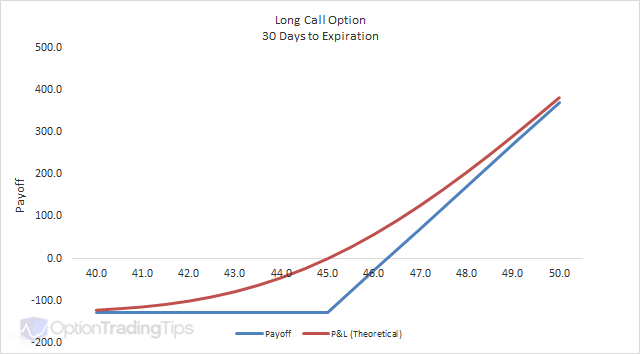
| B/S | Strike | Type | Price |
|---|---|---|---|
| Buy 1 | $45 | Call | $1.29 |
| Net Debit | $129 | ||
A long call option gives the buyer the right to buy the underlying asset at the strike price. The option buyer pays a premium for this right to the seller of the option.
The Max Loss will only ever be the premium that is paid up front to buy the option.
The Max Gain is uncapped and will rise with as long as the underlying price rises.
Characteristics
When to use: When you are bullish on market direction and also bullish on market volatility.
A long call option is the simplest way to benefit if you believe that the market will make an upward move and is the most common choice among first time investors.
Being long a call option means that you will benefit if the stock/future rallies, however, your risk is limited on the downside if the market makes a correction.
From the above graph you can see that if the stock/future is below the strike price at expiration, your only loss will be the premium paid for the option. Even if the stock goes into liquidation, you will never lose more than the option premium that you paid initially at the trade date.
Not only will your losses be limited on the downside, you will still benefit infinitely if the market stages a strong rally. A long call has unlimited profit potential on the upside.
Long Call Greeks
Delta


Gamma


Vega


Theta


201 Comments
Newbz February 29th, 2012 at 8:10pm
Thanks for the help, Peter.
Options trading looks like a good fit for someone like me who has a small amount of risk capital but still wants to invest. I want to get as much info about options as possible.
Peter February 29th, 2012 at 6:39pm
Correct, the new buyer of the option will exercise his/her contract against another participant who is short the option.
Yes, the long/short terminology applies to both call and put options.
Newbz February 29th, 2012 at 5:54pm
Peter,
If I understand you correctly is this what you're basically saying:
1) I buy an Options Contract for $100
2) The value of the contract goes up to $110
3) I sell the contract and make a $10 profit.
4) The new owner of the contract exercises the position and I'm not the one covering it.
Does this scenario apply to both Call and Put options I "long" (if I'm using that term properly, I mean "buy")?
Peter February 29th, 2012 at 4:06pm
Hi Newbz, if you buy and then sell the same option then you no longer have a "position" and hence cannot have your option exercised.
You can only be exercised when you have a short position in an option i.e. you've sold the option without first holding the contract.
Newbz February 29th, 2012 at 3:23pm
This is going to sound like a dumb question, but I can't get a clear answer on it:
If I buy an option then sell the option, does that mean I have to cover the option if the new owner exercises it or does the one who originally wrote the contract cover it?
Peter February 28th, 2012 at 6:48pm
Congrats on your first trade Brian! How did it go...did you make some money?
Peter February 28th, 2012 at 6:46pm
Hi Sam,
The options that are deeper in the money will have higher premiums than the options closer to the current trading price, so I would be inclined to sell those first. Unless you have expectations that the stock will trade higher, then you might want to consider holding and selling later.
Brian February 28th, 2012 at 1:59pm
Hi again,
Sorry for the confused question earlier, I figured it out. A bit of jitters as this was my first Options trade. Thanks!
Sam February 28th, 2012 at 11:19am
Peter,
If I have two call options under my employee stock option plan each with same expiration date but different strike prices, which one of these do I sell first (assuming I want to sell before expiration). All of these are in the money. Do I sell the one deeper in the money with lower premiums or the one closer to the trading price with higher premiums?
Note that this is company stock option grants and there is no up front capital. My guess would be the one closer to the current trading price of the stock as those have higher premiums.
Just wanted to confirm.
Thanks,
Sam.
Brian February 28th, 2012 at 8:51am
Peter,
Your site and comments are some of the most useful I have found online, so thanks for that.
I have a question regarding a call option position I would like to close. It appears that I could sell with the stock under the strike price, but make $3 per share on the premium. Would it not be better to sell for the premium versus hoping that it surpasses the strike by enough to match that gain?
Thanks!
Add a Comment