Long Put Option
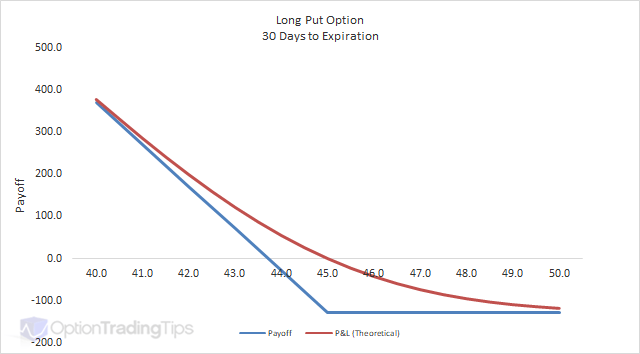
| B/S | Strike | Type | Price |
|---|---|---|---|
| Buy 1 | $45 | Put | $1.29 |
| Net Debit | $129 | ||
A long put is the purchase of a put option.
The Max Loss is limited to the net premium paid for the option.
The Max Gain is uncapped as the market falls but limited to the strike price minus the stock price as the stock cannot trade lower than zero.
Characteristics
When to use: When you are bearish on market direction and bullish on market volatility.
Like the long call a long put is a nice simple way to take a position on market direction without risking everything. Except with a put option you want the market to decrease in value.
Buying put options is a fantastic way to profit from a down turning market without shorting stock. Even though both methods will make money if the market sells off, buying put options can do this with limited risk.
Long Put Option Greeks
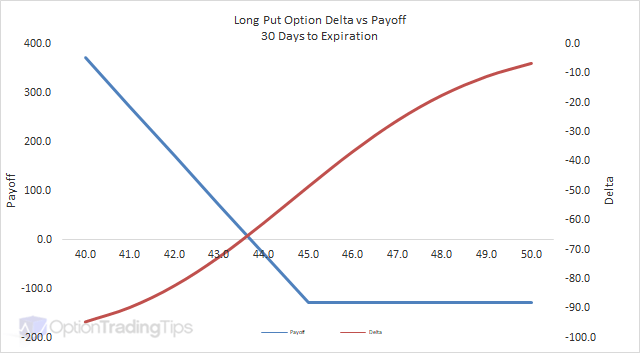
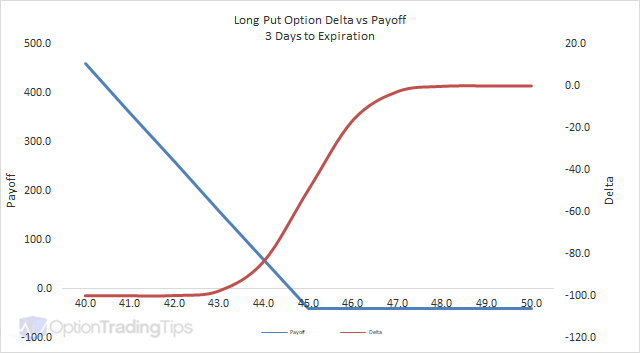
Delta
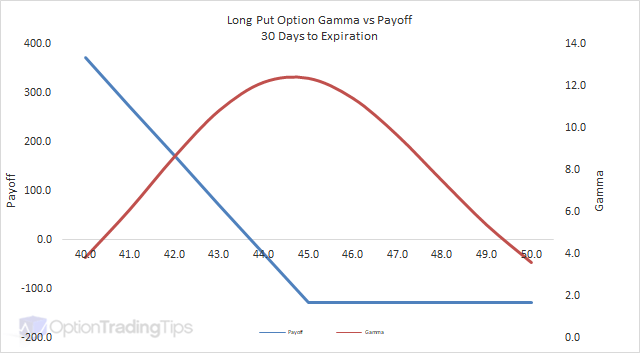
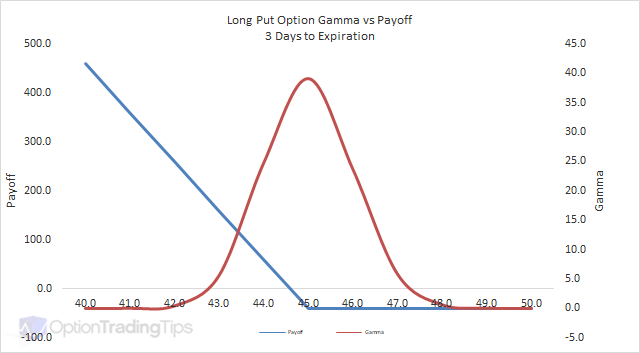
Gamma
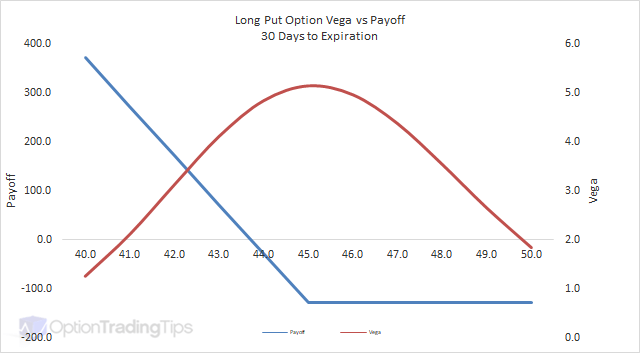
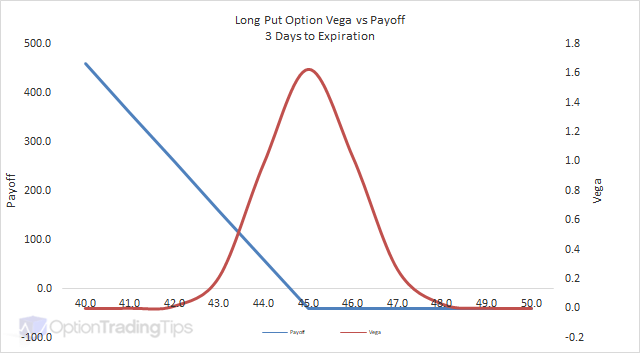
Vega
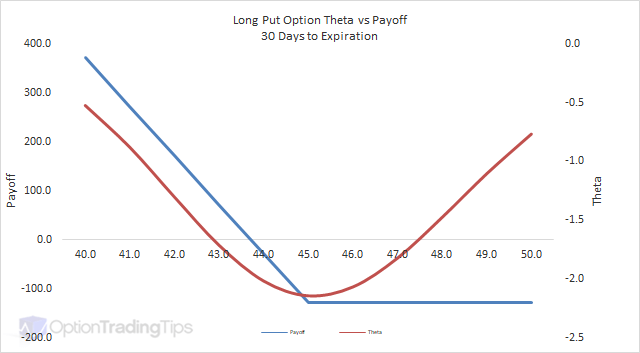
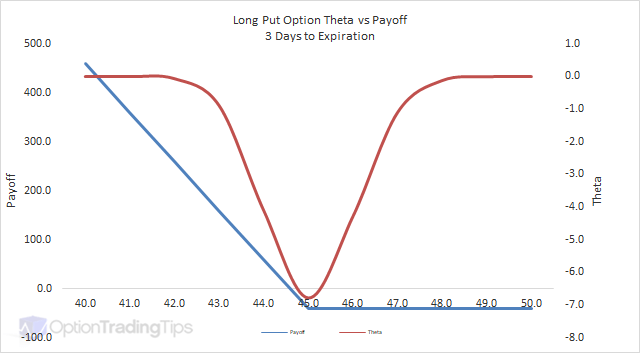
Theta
57 Comments
Shawn December 30th, 2011 at 12:54am
I just got finished using the P/L Calculator on optionshouse paper trading and tried a couple different combinations, one in particular that i would appreciate some insight on. XYZ is trading at $40, and purchasing 3-$39 calls @$1.12 and a 3-$41 [email protected]. From 40 to 41.36 its a loss(max $36), looking at the monthly chart the stock has moved in a $2.50-$4 range for the entire ytd. $804 total investment; $2-$4 down returns $300-850; $2 up returns $100-$650. The problem here is it seems to good to be true. Am I misinterpreting something OR does that sound about right?
Bev November 10th, 2011 at 1:56am
Thanks for shedding MUCH needed light on that and guidance to other means to close a position.
Peter November 2nd, 2011 at 4:55pm
Hi Bev,
Sure, you can wait until the expiration date and exercise the option but this will require capital to take on the position. However, you won't have any trouble getting out of the position if you really want to.
The option market makers will always be there to take the other side of your order. If there isn't a bid ask market there you can perform a "quote request" (if the market and platform supports it) where market makers will respond with a double sided quote.
If not, then you can place an order yourself and adjust it until someone takes it. Once the order is priced above the option's intrinsic value you will definitely get hit on it.
Bev October 31st, 2011 at 5:26pm
I have bought long put contracts on a stock currently selling for 8 dollars. It is expected to easily move down to 6 dollars or less. I bought 40 contracts at 1.00 (100 dollars a contract) and the current open interest including mine is now 119 contracts. Not a lot of volume in other words. For such inexpensive stocks (and currently low open interest) is there a point you had best sell? In other words, say I held the option until it went down to 4 dollars. Who would buy this now expensive put option from me for say 3 dollars when they can just short the stock itself for 4 dollars?
Or can I hold it until it would reach the 4 dollar mark and then exercise it? Using an online trading platform, how do you actually exercise it? I have only closed the option contracts in the past so not sure how that works?
Great site by the way - most appreciated.
MAHENDRA KUMAR October 28th, 2011 at 11:30pm
Buying put is the opposite of buying a call. When you buy a call option you are bullish about the stock/index. When an investor is bearish he can buy a put option. A put option gives the buyer of the put option a right to sell the stock (to the put seller) at a pre-specified price and thereby limit his risk.
Peter October 19th, 2011 at 4:18am
No, that's the advantage with buying options - your maximum loss can only be the premium paid when you bought the option.
Dave October 18th, 2011 at 7:12am
I purchased (BUY) a put option that is about to expire worthless. I wanted the price to drop when I bought the put, and it didn't it went higher... I do not own the underlying stock. Is there any more risk of loss if this position expires other than the cost of the initial trade?
Peter September 29th, 2011 at 5:48pm
If the option is American Style then it can happen either at expiration or when the buyer of the option chooses to exercise.
If the option is European it only happens at expiration.
Applebox September 29th, 2011 at 1:00pm
Question on selling puts...
Am I put shares when the strike price is met automatically? Or does this only happen at expiration?
Thanks!
Bob September 9th, 2011 at 10:25am
Great info Peter, thank you.
Also, I had another put of mine on my mind when I wrote that last post. But the put I was referencing to you is actually a two letter designation for a german bank, just so I haven't thoroughly confused you or anyone.
Thanks again!
Add a Comment